Showing posts with label shower thoughts. Show all posts
Showing posts with label shower thoughts. Show all posts
Tuesday, 13 February 2018
Some Timely Fundamentals of Encryption

Tuesday, 12 September 2017
Left-brain creativity
One commonly cited way to improve or maintain mental health is to do something creative, such as painting, drawing, writing, dancing, making music, knitting or cooking. So what's the strategy to gain these benefits if you're not creatively inclined in these or any similar ways? What if you're, say, a statistician or a software engineer?
This post is about acknowledging other, more mathematical means of being creative, that aren't general thought of as traditionally creative. I'm calling these 'left-brain' creative means, which is reductionist, but easy to convey. Whether any of these are artistic in any way is irrelevant.
Martin Gardner was a master of left-brain creativity. He wrote books of mathematical puzzles and novelties, including a version of mini chess mentioned here. Making these challenges was absolutely creative. I would argue that the process of solving these puzzles would also be creative because it requires imagination and decisions that are novel to the solver.
Reiner Knizia has a PhD in mathematics and makes board games for a living. His visual artwork is rudimentary, which is fine because it's meant merely as dressing for the real creative work of abstract sets of rules meant to inspire clever player behaviour.
I mention these two first because I have been disparaged before for being un-creative when I would rely on similar abstractions as outlets. For instance, when told by (now ex-) girlfriend to go try to do something creative, I started working on a farming game I had envisioned, and decided to start with a list of livestock and a draft of their prices in the game. This didn't impress her.
With building toys, I usually made abstract patterns rather than anything that would traditionally have been considered creative. With Lego / Mega Blocks, my most memorable builds were a giant hollow box for holding hockey pucks, and an extremely delicate staircase. With K'nex, my work was always abstract shapes made in an ad-hoc manner.
I enjoy the concept of building toys a lot more more than actually building anything with them. It's a dream of mine that Capsella toys will make a return through 3D printing. Capsella was a toy make of clear plastic capsules with gears inside. It would be difficult, but doable.
There's also this game called Gravity Maze, in which the goal is to drop a marble in one tower of cubes and have it land in a target cube. The game comes with a set of puzzle cards which include a starting configuration of towers and a set of towers that you need to add to finish the maze. The game only comes with 60 such puzzle cards and additional ones aren't available for sale. On one vacation, I took it upon myself to draft a program that could randomly generate configurations and see if they were solutions. It's still in a notebook somewhere. Is this creative? It feels better if I think of it that way; doing this gave me the same joy I imagine someone gets from more traditional creative exploits.
On another vacation, I wrote a proof of concept for Gaussian elimination of a 4x4 matrix where the matrix was populated with fractions. The point was to write the entries of the resulting matrix each as a single fraction. That way, an ASIC (Application Specific Integrated Circuit) could later be made to solve such a matrix in fractions, which avoids the computationally slow method of subtraction, which is typically done through iterated subtraction. Was that creative? It felt a lot like doodling or sketching to decide upon this and solve it.
I was a big fan of Dungeons and Dragons, and later Rifts and GURPS, when I was younger. I almost never played roleplaying games, but I spent a lot of time reading rulebooks and compendiums, and writing my own material such as new monsters. To someone expecting creative work to look more like art, this probably resembled accounting.
This clearly isn't a new discovery to a lot of people. Just looking at websites for chess variants and chess puzzles tell me that much, along with the large custom card making subset of the Magic: The Gathering community tell me this much. There are many people that seem to enjoy making up challenges and rulesets and get creative joy out of it.
If there's a thesis to this post, it's that if you're not inclined to make what would be typically considered art, you can still reap the mental health benefits of being creative through more 'left-brain' means. Other activities worth mentioning, but not from personal experience, include making crossword puzzles, nurikabe puzzles, maps, and fractals. Do something that involves building or making and a lot of small decisions, and don't worry about whether it's expressive, artistic, or traditionally considered creative.
This post is about acknowledging other, more mathematical means of being creative, that aren't general thought of as traditionally creative. I'm calling these 'left-brain' creative means, which is reductionist, but easy to convey. Whether any of these are artistic in any way is irrelevant.
Martin Gardner was a master of left-brain creativity. He wrote books of mathematical puzzles and novelties, including a version of mini chess mentioned here. Making these challenges was absolutely creative. I would argue that the process of solving these puzzles would also be creative because it requires imagination and decisions that are novel to the solver.
Reiner Knizia has a PhD in mathematics and makes board games for a living. His visual artwork is rudimentary, which is fine because it's meant merely as dressing for the real creative work of abstract sets of rules meant to inspire clever player behaviour.
I mention these two first because I have been disparaged before for being un-creative when I would rely on similar abstractions as outlets. For instance, when told by (now ex-) girlfriend to go try to do something creative, I started working on a farming game I had envisioned, and decided to start with a list of livestock and a draft of their prices in the game. This didn't impress her.
With building toys, I usually made abstract patterns rather than anything that would traditionally have been considered creative. With Lego / Mega Blocks, my most memorable builds were a giant hollow box for holding hockey pucks, and an extremely delicate staircase. With K'nex, my work was always abstract shapes made in an ad-hoc manner.
I enjoy the concept of building toys a lot more more than actually building anything with them. It's a dream of mine that Capsella toys will make a return through 3D printing. Capsella was a toy make of clear plastic capsules with gears inside. It would be difficult, but doable.
There's also this game called Gravity Maze, in which the goal is to drop a marble in one tower of cubes and have it land in a target cube. The game comes with a set of puzzle cards which include a starting configuration of towers and a set of towers that you need to add to finish the maze. The game only comes with 60 such puzzle cards and additional ones aren't available for sale. On one vacation, I took it upon myself to draft a program that could randomly generate configurations and see if they were solutions. It's still in a notebook somewhere. Is this creative? It feels better if I think of it that way; doing this gave me the same joy I imagine someone gets from more traditional creative exploits.
On another vacation, I wrote a proof of concept for Gaussian elimination of a 4x4 matrix where the matrix was populated with fractions. The point was to write the entries of the resulting matrix each as a single fraction. That way, an ASIC (Application Specific Integrated Circuit) could later be made to solve such a matrix in fractions, which avoids the computationally slow method of subtraction, which is typically done through iterated subtraction. Was that creative? It felt a lot like doodling or sketching to decide upon this and solve it.
I was a big fan of Dungeons and Dragons, and later Rifts and GURPS, when I was younger. I almost never played roleplaying games, but I spent a lot of time reading rulebooks and compendiums, and writing my own material such as new monsters. To someone expecting creative work to look more like art, this probably resembled accounting.
This clearly isn't a new discovery to a lot of people. Just looking at websites for chess variants and chess puzzles tell me that much, along with the large custom card making subset of the Magic: The Gathering community tell me this much. There are many people that seem to enjoy making up challenges and rulesets and get creative joy out of it.
If there's a thesis to this post, it's that if you're not inclined to make what would be typically considered art, you can still reap the mental health benefits of being creative through more 'left-brain' means. Other activities worth mentioning, but not from personal experience, include making crossword puzzles, nurikabe puzzles, maps, and fractals. Do something that involves building or making and a lot of small decisions, and don't worry about whether it's expressive, artistic, or traditionally considered creative.
Sunday, 13 August 2017
Sports questions - Speculation, RISP, and PEDs
What will popular sports look like in the year 2030? (All sports)
Technology is rapidly making new sports possible.
Will improved cameras and laser gates make races with running starts viable? I would love to know how much faster the 100 metre dash can be without starting from a standstill.
Will drone racing or drone hunting take flight? Will e-sports continue their growth and penetration into the mainstream?
Will drone racing or drone hunting take flight? Will e-sports continue their growth and penetration into the mainstream?
Will self driving cars start competing in Nascar? Formula One? Rally car racing? Will all of these racing formats survive or maintain their scale in the next 15-20 years?
Demographics are opening new possibilities too.
Shrinking populations and urbanization are leaving behind many otherwise livable and usable buildings as abandoned. Will terrain-based sports like airsoft and paintball take off with the abundance of good locations? Will GoPro and similar robust and portable camera make such pursuits into spectator sports?
Will we see a shift of focus towards women in sport, following the trend of tennis? Will we see mixed-sex competition in sports where size and muscle mass mean less?
Will extreme sports see a revival, led by Red Bull sponsored events like Crashed Ice and Flugtag?
Will UFC mixed martial-arts continue to eat into the viewing market share of WWE wrestling? Why didn't Texas Hold 'em keep its hold on the public? Could the NHL (and the KHL) mismanage ice hockey into a fringe sport? Can American Football maintain its popularity in the face of growing concern over brain injury? Will American football adapt? Can golf maintain its popularity given its cost?
What about stadiums?
Instead of building stadiums for specific sports, or a limited set of sports, will new sports emerge to fit into already made stadiums? Will existing sports start to use stadiums that were built for other purposes, such as softball in a baseball stadium, or soccer football in an American football stadium?
On RISP, Runners In Scoring Position. (Baseball)
Batters
do better (or pitchers do worse) when there are runners in scoring
position. Why? Is it just a result of skill auto-correlation, such as a
pitcher's tendency to do poorly in streaks of batters, or is it
something else? Is it the distraction on the pitcher for having a batter
who could steal a base or read signs? Is it the effect of the fielders
having to do more than one job at once?
A
more measurable or actionable question: is the RISP advantage greater
for certain batters? For example does a player with a reputation for
stealing bases give a larger 'RISP bonus' than another with ordinary
base-running. Does the effect add with multiple runners? Does it change
with base? Does it change with pickoff attempts? How much of this is
balks being drawn?
Similarly,
how should pickoff attempts be counted with regards to pitching load?
My guess is that they have the effect of about half a pitch in terms of
performance in that game and in that plate appearance.
What performance enhancers are 'fair'? (All sports)
A lot of drugs are banned from a lot of sports, but why? My assumption is that it makes the feats of one era comparable to another. We can take Usain Bolt's running records and compare them to the records of Donovan Bailey's in the 90's, and say with little or no argument that Bolt at his peak was faster than Bailey at his. The difference in their 100 metre dash times can isolated to the runners and not the chemical technology of their respective eras.
My assumption comes from the qualifying statements in hockey and baseball about different eras of each sport defined by seemingly minor changes in the equipment or rules of the game. Hitting feats from the 1990s seasons of MLB baseball are qualified with comments about steroid use by superstar hitters. Steroid use was allowed at the time, I presume on the basis that every player had access to the steroids.
Why is chemical technology is seen as unfair and other technology like improved running shoes is fair? Probably the hidden nature of drugs, and the related difficulty in directly regulating the 'equipment' used. It's much simpler to enforce rules about the volume of a golf club face, or the curvature of a hockey stick, rather than an acceptable dosage of steroids.
Things have gotten confusing lately.
Oscar Pistorius, whom had both his legs amputated below the knee as an infant, was until recently a competitive paralypmic sprinter. He used springy blades, described here, to run. He also wanted to compete in general sprinting competition but was barred from general competition as it was found that his prosthetic feet were more efficient for running than baseline human feet. So, even though paralypmic competition was designed to provide viable competition to those with physical disabilities, the technology used to mitigate Pistorius's disability was deemed too effective.
In January 2017, the IOC (International Oympic Committee) released the results of testing they had done on various drugs to test for performance enhancement in, of all things, chess. They found that caffeine, Ritalin, and Adderal all improved performance in double blind tests. So, if chess ever becomes an Olympic sport, should these drugs be banned and tested for? What happens if someone has a prescription for Ritalin, do they have to go without to compete?
Things are about to get a lot more confusing.
CRISPR is a technology that may have the potential to arbitrarily rewrite genetic code. If done to a human embryo to specialize the resulting human into a particular sport, what are the rules to be surrounding that? Generic editing seems like drugs and blood doping in that it's a hidden technology that would be very complicated to regulate other than to ban completely. It would be at least intended to be performance enhancing, and not every competitor would have access to the technology, at least not at first.
But changing the genetics of a person is not adding something foreign to the person, it is changing who that person is. That's who that person will be through their entire life growing up. Should we ban someone from competition for being 'naturally' too good at something as a result of a decision made before that person's birth?
Or, do we separate competitors into 'baseline' and 'enhanced' humans? This is starting to sound way more like a dystopian, racist dog show (with terms like 'best in breed') than the 'faster, higher, stronger' tone I was aiming for. It's something we collectively need to think about though, not just for sport but for all human interaction going forward.
Let's close with this thought on the subject by speedrunner Narcissa Wright: "All the categories are arbitrary".
Saturday, 3 December 2016
2016 did not suck.
The idea 2016 sucked is an indication of the triumph of media over statistics.
In the United States, which I use because their data is very open and thorough, national unemployment is less than 5% and has been steadily dropping. Of those unemployed, most of them are either between jobs by choice, or have not yet ever had major employment. We know this because the proportion of the workforce on unemployment assistance is below 1.20%, the lowest rate in more than 40 years.
Also in the US there was also a record low number (not proportion, raw number) of teenage pregnancies. That means both fewer abortions AND fewer unwanted births. So if you're pro-choice or pro-life, your side is winning.
Globally, the birth rate is falling faster than previously forecast, largely because of faster-than-forecast improvements to the quality of life in India. Last month, the Indian government target for solar power capacity was raised dramatically foe the 3rd time in 6 years because the bringing clean energy to people keeps getting easier and cheaper at a rate faster than anyone could reasonably expect.
Compared to 2015, worldwide sales of electric cars has increased 55%, worldwide use of coal has decreased. Anthropogenic (Man-made) carbon emissions were the same as 2015, despite the world economy growing. This is an indication that we could get climate change under control.
A lot of the problems of the last couple of years were either mitigated well in 2016, or outright handled.
Remember Ebola? The outbreak is officially over, and was close to over for most of 2016. There is a vaccine that's currently in use, and if something goes wrong, we have another vaccine candidate in Phase III (late human-equivalent testing) trials to take its place. This was the ultimate Ebola outbreak - not just the biggest but the last we will ever see.
Remember the Fukushima disaster? Radioactivity in most (not within a km of the damaged reactor) of the region has dropped to levels fit for permanent human habitation. After the disaster, Japan shut down all their nuclear power plants for years for safety upgrades, and 2016 saw the last of them come back online. What happened with the Fukushima reactor was extraordinary, and problem of that magnitude is impossible for CANDU modern reactors.
Remember Zika? The outbreak has been contained. There are scattered reports of new cases, but it's not showing up all over the world as was predicted after the Rio Olympics. On that note, the Rio Olympics seemed unremarkable as far as mishaps and problems are concerned. I saw Rio de Janerio in October. It looked like it has survived well enough.
Remember that war that started in 2016? Me neither. A cursory search finds no armed conflict between two or more different countries that started this year.
You can remember 2016 as the year we lost Alan Rickman, but 40 million people will remember it as the year they got access to clean water.
In the United States, which I use because their data is very open and thorough, national unemployment is less than 5% and has been steadily dropping. Of those unemployed, most of them are either between jobs by choice, or have not yet ever had major employment. We know this because the proportion of the workforce on unemployment assistance is below 1.20%, the lowest rate in more than 40 years.
Also in the US there was also a record low number (not proportion, raw number) of teenage pregnancies. That means both fewer abortions AND fewer unwanted births. So if you're pro-choice or pro-life, your side is winning.
Globally, the birth rate is falling faster than previously forecast, largely because of faster-than-forecast improvements to the quality of life in India. Last month, the Indian government target for solar power capacity was raised dramatically foe the 3rd time in 6 years because the bringing clean energy to people keeps getting easier and cheaper at a rate faster than anyone could reasonably expect.
Compared to 2015, worldwide sales of electric cars has increased 55%, worldwide use of coal has decreased. Anthropogenic (Man-made) carbon emissions were the same as 2015, despite the world economy growing. This is an indication that we could get climate change under control.
A lot of the problems of the last couple of years were either mitigated well in 2016, or outright handled.
Remember Ebola? The outbreak is officially over, and was close to over for most of 2016. There is a vaccine that's currently in use, and if something goes wrong, we have another vaccine candidate in Phase III (late human-equivalent testing) trials to take its place. This was the ultimate Ebola outbreak - not just the biggest but the last we will ever see.
Remember the Fukushima disaster? Radioactivity in most (not within a km of the damaged reactor) of the region has dropped to levels fit for permanent human habitation. After the disaster, Japan shut down all their nuclear power plants for years for safety upgrades, and 2016 saw the last of them come back online. What happened with the Fukushima reactor was extraordinary, and problem of that magnitude is impossible for CANDU modern reactors.
Remember Zika? The outbreak has been contained. There are scattered reports of new cases, but it's not showing up all over the world as was predicted after the Rio Olympics. On that note, the Rio Olympics seemed unremarkable as far as mishaps and problems are concerned. I saw Rio de Janerio in October. It looked like it has survived well enough.
Remember that war that started in 2016? Me neither. A cursory search finds no armed conflict between two or more different countries that started this year.
You can remember 2016 as the year we lost Alan Rickman, but 40 million people will remember it as the year they got access to clean water.
Friday, 22 July 2016
The Globalization of Baseball
As I write this, pro baseball player Ichiro Suzuki is on the verge of getting his 3,000th big-league hit*.
There's a big asterisk there because Ichiro has nearly 3,000 hits in the North American leagues (Major League Baseball, MLB), but has about 4,300 if you include his hits in the professional Japanese leagues (Nippon Pro Baseball, NPB) as well. Ichiro came from Japan when that was a lot rarer, and perhaps at an older age (27), so it's hard to compare him fairly to players anywhere, other to say he's a global all-star.
Baseball is a global game, and it's becoming more international quickly. Here are some trends I've seen that show increasing ties between baseball in North America and the rest of the world. My hope is for more MLB exhibition games overseas, and eventually overseas inter-league play, especially with Nippon Pro Baseball.
1. The World Baseball Classic
In 2006, 2009, and again in 2013, the USA hosted a world tournament modeled after the FIFA World Cup. The tournaments themselves are a sign that international baseball is strong enough to continue without the support of the Olympics, but the results are an even stronger sign. The team from Japan won the 2006 and 2009 WBCs and placed third in 2013. Cuba won second place in 2006. The USA has not yet placed higher than fourth.
The next World Baseball Classic will be in 2017.
In 2006, the team from Cuba was only allowed entry to the United States because other countries refused to play without them.
2. The end of the Cuban embargo
Earlier this year, the United States officially ended its cold war remnant embargo on Cuba. Cuba has been a source of baseball talent for many years, but in order to play for MLB during the embargo, a player would need to defect to the United States, leaving their old life behind completely. Most of Cuba's world-class superstars may have already done this before the embargo was removed, but what about the ones that could have been professional baseball players, but didn't invest the training time because of the risks and costs involved in defection?
We will see many more Cuban professional players, but it will take a couple of years.
3. Twenty-20 Cricket
Until 2005, professional cricket matches lasted either eight hours, or up to five days. The Twenty20 format of cricket changed that by introducing a three-hour game. This change makes individual cricket matches a lot more appealing to North American sports fans, whom are already used to Football, Soccer, Hockey, and Baseball games which all last about three hours including non-play time.
There are substantial differences between cricket and baseball, but the skill sets are related. Both games focus their action on a single ball thrower and ball hitter, with the remaining play happening among the fielders (9 in baseball, 11 in cricket).
With time and television, this could lead to flow of talent between the sports, with amateur players trying to increase their play time and career prospects by being involved in both sports.
4. The precedent of Inter-League Play
Major League Baseball is split into two leagues of 15 teams each. This is a more meaningful break than that between conferences in hockey or basketball. The two leagues in MLB play by different sets of rules. There are several minor differences, and one big one: the designated hitter. In the American League (which includes the Toronto Blue Jays), there is a designated hitter whose only role is to bat. In the National League, there is no designated hitter, and the pitcher (thrower, like a bowler), must also bat.
Despite this rule difference, American and National League teams play against each other regularly. The game is played by the rules of the home team. Play between MLB and Japanese NPB would likely work the same way, and having the precedent of playing by the home team's rules makes that inter-league play simpler to establish.
5. The video appeal system
According to [2], the Japanese style is for umpires to huddle together and make a call through consensus; American decisions are made by the official in the best physical place to witness the event in question.
Starting in the 2016 season in MLB, when a call is appealed, the video footage is reviewed by a central panel of officials in New York and an ultimate decision is made there. This new system making the most important or contentious calls are made by consensus. This reduces the distance between the two styles.
6. The Posting System
Since 1998, MLB and NPL have used an agreement called the Posting System regarding NPL players leaving Japan and playing in MLB instead. The merits or weaknesses of this system are beyond me, but at least it sets a precedent of coordination between to the two league systems. Ichiro was the second player to join the MLB under the Posting System. See [3] for more.
7. Interleague play with Major League Soccer
European soccer has lots of interaction between leagues. The best of each of the English Premier League, Spain's La Liga, Germany's Bundesliga, and others earn places in the UEFA Champion's League. Back in North America, Major League Soccer (MLS) has been more isolated, but that is changing.
There is a growing trend of star players from UEFA teams playing in MLS when their best years are over. They're still competitive in MLS, and names like Kaka and David Beckham bring in crowds.
There are also more games happening between MLS teams and those from the English Premier League. This month, the Vancouver Whitecaps FC tied 2-2 against Crystal Palace, and the Seattle Sounders beat West Ham 3-0.
Any commercial success from these matches is a signal to Major League Baseball that they could do the same, and that there is fan interest in the overseas matches.
[1] Japanese Baseball Rules and Customs
http://factsanddetails.com/japan/cat21/sub141/item771.html
[2] On the cultural distances in baseball
http://www.umich.edu/~wewantas/brooke/differences.html
[3] The Posting System, which describes how players are transferred between leagues
https://en.wikipedia.org/wiki/Posting_system
There's a big asterisk there because Ichiro has nearly 3,000 hits in the North American leagues (Major League Baseball, MLB), but has about 4,300 if you include his hits in the professional Japanese leagues (Nippon Pro Baseball, NPB) as well. Ichiro came from Japan when that was a lot rarer, and perhaps at an older age (27), so it's hard to compare him fairly to players anywhere, other to say he's a global all-star.
Baseball is a global game, and it's becoming more international quickly. Here are some trends I've seen that show increasing ties between baseball in North America and the rest of the world. My hope is for more MLB exhibition games overseas, and eventually overseas inter-league play, especially with Nippon Pro Baseball.
1. The World Baseball Classic
In 2006, 2009, and again in 2013, the USA hosted a world tournament modeled after the FIFA World Cup. The tournaments themselves are a sign that international baseball is strong enough to continue without the support of the Olympics, but the results are an even stronger sign. The team from Japan won the 2006 and 2009 WBCs and placed third in 2013. Cuba won second place in 2006. The USA has not yet placed higher than fourth.
The next World Baseball Classic will be in 2017.
In 2006, the team from Cuba was only allowed entry to the United States because other countries refused to play without them.
2. The end of the Cuban embargo
Earlier this year, the United States officially ended its cold war remnant embargo on Cuba. Cuba has been a source of baseball talent for many years, but in order to play for MLB during the embargo, a player would need to defect to the United States, leaving their old life behind completely. Most of Cuba's world-class superstars may have already done this before the embargo was removed, but what about the ones that could have been professional baseball players, but didn't invest the training time because of the risks and costs involved in defection?
We will see many more Cuban professional players, but it will take a couple of years.
3. Twenty-20 Cricket
Until 2005, professional cricket matches lasted either eight hours, or up to five days. The Twenty20 format of cricket changed that by introducing a three-hour game. This change makes individual cricket matches a lot more appealing to North American sports fans, whom are already used to Football, Soccer, Hockey, and Baseball games which all last about three hours including non-play time.
There are substantial differences between cricket and baseball, but the skill sets are related. Both games focus their action on a single ball thrower and ball hitter, with the remaining play happening among the fielders (9 in baseball, 11 in cricket).
With time and television, this could lead to flow of talent between the sports, with amateur players trying to increase their play time and career prospects by being involved in both sports.
4. The precedent of Inter-League Play
Major League Baseball is split into two leagues of 15 teams each. This is a more meaningful break than that between conferences in hockey or basketball. The two leagues in MLB play by different sets of rules. There are several minor differences, and one big one: the designated hitter. In the American League (which includes the Toronto Blue Jays), there is a designated hitter whose only role is to bat. In the National League, there is no designated hitter, and the pitcher (thrower, like a bowler), must also bat.
Despite this rule difference, American and National League teams play against each other regularly. The game is played by the rules of the home team. Play between MLB and Japanese NPB would likely work the same way, and having the precedent of playing by the home team's rules makes that inter-league play simpler to establish.
5. The video appeal system
According to [2], the Japanese style is for umpires to huddle together and make a call through consensus; American decisions are made by the official in the best physical place to witness the event in question.
Starting in the 2016 season in MLB, when a call is appealed, the video footage is reviewed by a central panel of officials in New York and an ultimate decision is made there. This new system making the most important or contentious calls are made by consensus. This reduces the distance between the two styles.
6. The Posting System
Since 1998, MLB and NPL have used an agreement called the Posting System regarding NPL players leaving Japan and playing in MLB instead. The merits or weaknesses of this system are beyond me, but at least it sets a precedent of coordination between to the two league systems. Ichiro was the second player to join the MLB under the Posting System. See [3] for more.
7. Interleague play with Major League Soccer
European soccer has lots of interaction between leagues. The best of each of the English Premier League, Spain's La Liga, Germany's Bundesliga, and others earn places in the UEFA Champion's League. Back in North America, Major League Soccer (MLS) has been more isolated, but that is changing.
There is a growing trend of star players from UEFA teams playing in MLS when their best years are over. They're still competitive in MLS, and names like Kaka and David Beckham bring in crowds.
There are also more games happening between MLS teams and those from the English Premier League. This month, the Vancouver Whitecaps FC tied 2-2 against Crystal Palace, and the Seattle Sounders beat West Ham 3-0.
Any commercial success from these matches is a signal to Major League Baseball that they could do the same, and that there is fan interest in the overseas matches.
[1] Japanese Baseball Rules and Customs
http://factsanddetails.com/japan/cat21/sub141/item771.html
[2] On the cultural distances in baseball
http://www.umich.edu/~wewantas/brooke/differences.html
[3] The Posting System, which describes how players are transferred between leagues
https://en.wikipedia.org/wiki/Posting_system
Saturday, 28 May 2016
The NHL is half as good as it should be.
The soul of the National Hockey League feels like it's gone.
1. Every 8 years or so, at least half, sometimes a whole season is simply lost because of labor dispute. The backbone of sport is ritual and tradition, and a ritual adhered to only sometimes is just a habit.
2. Teams are playing to tie instead of to win, as demonstrated by fivethirtyeight, and later in greater detail in a paper I'm writing with Paramjit Gill. Half a win is awarded to any team that loses in overtime, and this incentivizes some very risk-averse behaviour late in games. Despite other changes to overtime including
- the introduction of a shootout,
- 4-on-4 overtime play, and later
- 3-on-3 overtime play, the overtime bonus point has persisted.
3. Some teams are hopeless year-after-year failures. In the past, expansion teams have had one or two terrible seasons while they get established, but no team has that excuse now. There are several 'rubber band' mechanics in play to pull the level of competitiveness of teams closer together over time.
- There is an upper limit on the total salaries that can be paid to players, and many teams are at this limit.
- Top-earning teams subsidize other teams.
- Teams that rank at the bottom in one season are given first pick of players in next year's draft.
The overtime bonus is itself a form of rubber-banding because a team can still earn season points by losing, and if the game goes to a shoot-out, then the game is effectively a coin toss regardless of team strength.
In spite of all these mechanics to prop up teams after a bad season, there are some have been hopeless for a decade. Looking at you, Oilers.
My guess is that isn't enough talent coming from second-tier 'feeder' leagues (WHL, OHL, QMJHL, AHL, and the European leagues) to properly fill 30 NHL teams anymore. In turn, these feeder leagues are working from a diminished talent pool because of demographic changes; compared to 15 years ago, there are fewer children being born in hockey-playing countries, and their parents are poorer and less able to enroll these children in organized hockey.
Here are my suggestions to improve the state of professional hockey.
1. Remove (at least) two teams from the league.
As a Canadian, my inclination would be to remove the Arizona Coyotes and the Columbus Blue Jackets because of their tiny home fanbases and financial troubles. Realistically, the Edmonton Oilers should go, simply for being the worst.
With 28 teams, all four divisions could have 7 teams, and the talent would be spread 7% less thinly. Cutting out a couple teams might be enough deterrent to 'diving', an alleged practice where bottom-tier teams intentionally lose games to improve their draft prospects for the next season.
2. Optimize the talent pool.
The first chapter of the book Outliers points out the phenomenon where boys born in the first 3 months of the year are overwhelmingly more likely to make a career out of hockey. The explanation given for this was that, as a fluke of the age cutoff system for children's leagues, these children of January are the oldest of their 4-6 year old peers on the ice. Since they are the best players in their leagues, they get filtered into more competitive leagues with better support. To my knowledge, Hockey Canada still uses this cutoff system.
Players that were both late in the year that may have been NHL material instead never reach their potential because they were outclassed and looked over when they were very young. Fairness aside, if early age cutoffs were done at 6-month intervals instead of 1-year intervals, we could see more players at their potential.
We wouldn't notice the difference for a generation, but it would offset future demographic changes.
3. Increase support for women's hockey.
At the moment there are only a handful of competitive teams in women's hockey in Canada, so the developed talent pool can't be exceedingly large. Even then, the Canadian and US teams were so much better than teams from other countries that the IOC was considering removing women's hokcey from the olympics because it wasn't competitive enough. Things are improving, as Finland has been showing strength in recent competitions. If we want more high quality hockey, maybe it's time to look elsewhere.
1. Every 8 years or so, at least half, sometimes a whole season is simply lost because of labor dispute. The backbone of sport is ritual and tradition, and a ritual adhered to only sometimes is just a habit.
2. Teams are playing to tie instead of to win, as demonstrated by fivethirtyeight, and later in greater detail in a paper I'm writing with Paramjit Gill. Half a win is awarded to any team that loses in overtime, and this incentivizes some very risk-averse behaviour late in games. Despite other changes to overtime including
- the introduction of a shootout,
- 4-on-4 overtime play, and later
- 3-on-3 overtime play, the overtime bonus point has persisted.
3. Some teams are hopeless year-after-year failures. In the past, expansion teams have had one or two terrible seasons while they get established, but no team has that excuse now. There are several 'rubber band' mechanics in play to pull the level of competitiveness of teams closer together over time.
- There is an upper limit on the total salaries that can be paid to players, and many teams are at this limit.
- Top-earning teams subsidize other teams.
- Teams that rank at the bottom in one season are given first pick of players in next year's draft.
The overtime bonus is itself a form of rubber-banding because a team can still earn season points by losing, and if the game goes to a shoot-out, then the game is effectively a coin toss regardless of team strength.
In spite of all these mechanics to prop up teams after a bad season, there are some have been hopeless for a decade. Looking at you, Oilers.
My guess is that isn't enough talent coming from second-tier 'feeder' leagues (WHL, OHL, QMJHL, AHL, and the European leagues) to properly fill 30 NHL teams anymore. In turn, these feeder leagues are working from a diminished talent pool because of demographic changes; compared to 15 years ago, there are fewer children being born in hockey-playing countries, and their parents are poorer and less able to enroll these children in organized hockey.
Here are my suggestions to improve the state of professional hockey.
1. Remove (at least) two teams from the league.
As a Canadian, my inclination would be to remove the Arizona Coyotes and the Columbus Blue Jackets because of their tiny home fanbases and financial troubles. Realistically, the Edmonton Oilers should go, simply for being the worst.
With 28 teams, all four divisions could have 7 teams, and the talent would be spread 7% less thinly. Cutting out a couple teams might be enough deterrent to 'diving', an alleged practice where bottom-tier teams intentionally lose games to improve their draft prospects for the next season.
2. Optimize the talent pool.
The first chapter of the book Outliers points out the phenomenon where boys born in the first 3 months of the year are overwhelmingly more likely to make a career out of hockey. The explanation given for this was that, as a fluke of the age cutoff system for children's leagues, these children of January are the oldest of their 4-6 year old peers on the ice. Since they are the best players in their leagues, they get filtered into more competitive leagues with better support. To my knowledge, Hockey Canada still uses this cutoff system.
Players that were both late in the year that may have been NHL material instead never reach their potential because they were outclassed and looked over when they were very young. Fairness aside, if early age cutoffs were done at 6-month intervals instead of 1-year intervals, we could see more players at their potential.
We wouldn't notice the difference for a generation, but it would offset future demographic changes.
3. Increase support for women's hockey.
At the moment there are only a handful of competitive teams in women's hockey in Canada, so the developed talent pool can't be exceedingly large. Even then, the Canadian and US teams were so much better than teams from other countries that the IOC was considering removing women's hokcey from the olympics because it wasn't competitive enough. Things are improving, as Finland has been showing strength in recent competitions. If we want more high quality hockey, maybe it's time to look elsewhere.
Friday, 20 May 2016
Biochar farming idea
Here's an idea I hope gets stolen if it's good, and shot down early if it's bad. Also, I claim no expertise in biology, apiary science, or soil ecology, so this could be drastically off the mark.
1. Pyrolyze massive amounts of organic waste to make biochar.
2. Use the biochar to make a soil that mimics land after a forest fire.
3. Grow high-value crops that grow best after a forest fire.
4. Incorporate secondary processes like beehives.
------------
First, pyrolysis is a technique for burning lingen-rich plant matter (i.e. wood, bamboo, corn stalks) in a low oxygen environment. Pyrolysis can produce a stable, porous form of charcoal called biochar. Biochar is commonly applied to soil to improve its capacity to store water and nutrients. Soil with large amounts of biochar can approximate a very high quality topsoil call terra preta.
Also, the process of creating biochar is carbon-negative. The carbon in the biochar is effectively locked out of the atmosphere more permanently than it would be if the biological matter is left to rot. It certainly keeps carbon out of the atmosphere more effectively than simple burning.
What happens, however, when the soil is mostly biochar, with just enough other parts (or a layer on top) to keep it from blowing away? I suspect that you would have a soil similar to what would be found on the ground after a forest fire.
Pioneer species are the first organisms to thrive after a forest fire. These include valuable plants like morel mushrooms, and, particularly, fireweed. Specifically, I've heard that honey derived from fireweed is valuable. However, the cultivation of fireweed honey is difficult because it has to be done in areas of recent forest fires, and therefore can't be done in the same place for very long.
My idea is to make soil that mimics the ground after a recent fire, and maintain that state with frequent renewal of biochar. Then, I want to use that soil to cultivate pioneer species.
With enough biochar, my hope is to have some farmland that can grow fireweed every year, and have permanently installed beehives amongst the fireweed. Rather than move the hives to where the land is suitable, I will work to maintain the land in a suitable state. With luck, the practice will pay for itself in harvests of fireweed honey, morels, and excess biochar.
If this works, then it can become a business that is both long-term profitable and carbon negative. There is an established demand for morels, and with more consumer awareness there could be a large demand for fireweed honey, so there is room for lots of people to try this.
--------
One potential issue is that bees prefer some flowers to others, and growing fireweed near the beehives doesn't guarantee that those are the flowers that will be used. Having a honey with a precursor that was part fireweed and part wildflowers may be acceptable, but it even guaranteeing that would mean influence an area much larger than the farmland.
Another issue is a sustainable supply of lingen-rich organic matter. Piles of slash and scrap wood are unreliable, one-time sources. Corn husks work nicely, but aren't available everywhere. Low-grade wood chips, called hog, would also work, but those are already used by pulp mills for energy. The city of Vancouver is already collecting organic waste for industrial composting, so it may be possible to tap into that pipeline. It will take some research to find how to use whatever is regularly available from local food processing and agriculture.
--------
ADDENDUM: user Osageandrot on Reddit, who does research on biochar for soil restoration, was kind enough to critique this idea and give some input. It was enough to show that this idea needs a major rework before anything more goes forward with this
First, any fresh biochar would need to be pre-aged by mixing with existing soil. This is because Polycyclic Aromatic Hydrocarbons (PAHs) are in too high of a concentration originally, and these will suppress microbal life.
Second, fresh application of biochar may not be necessary anyways. Most pioneer species are simply fast growers that need anything else that grows slower, but to a higher maximum, to be gone. Forest fires are not a necessary ingredient for a lot of these, but they just happen to provide the necessary conditions; clearcutting would do the same thing.
1. Pyrolyze massive amounts of organic waste to make biochar.
2. Use the biochar to make a soil that mimics land after a forest fire.
3. Grow high-value crops that grow best after a forest fire.
4. Incorporate secondary processes like beehives.
------------
First, pyrolysis is a technique for burning lingen-rich plant matter (i.e. wood, bamboo, corn stalks) in a low oxygen environment. Pyrolysis can produce a stable, porous form of charcoal called biochar. Biochar is commonly applied to soil to improve its capacity to store water and nutrients. Soil with large amounts of biochar can approximate a very high quality topsoil call terra preta.
Also, the process of creating biochar is carbon-negative. The carbon in the biochar is effectively locked out of the atmosphere more permanently than it would be if the biological matter is left to rot. It certainly keeps carbon out of the atmosphere more effectively than simple burning.
What happens, however, when the soil is mostly biochar, with just enough other parts (or a layer on top) to keep it from blowing away? I suspect that you would have a soil similar to what would be found on the ground after a forest fire.
Pioneer species are the first organisms to thrive after a forest fire. These include valuable plants like morel mushrooms, and, particularly, fireweed. Specifically, I've heard that honey derived from fireweed is valuable. However, the cultivation of fireweed honey is difficult because it has to be done in areas of recent forest fires, and therefore can't be done in the same place for very long.
My idea is to make soil that mimics the ground after a recent fire, and maintain that state with frequent renewal of biochar. Then, I want to use that soil to cultivate pioneer species.
With enough biochar, my hope is to have some farmland that can grow fireweed every year, and have permanently installed beehives amongst the fireweed. Rather than move the hives to where the land is suitable, I will work to maintain the land in a suitable state. With luck, the practice will pay for itself in harvests of fireweed honey, morels, and excess biochar.
If this works, then it can become a business that is both long-term profitable and carbon negative. There is an established demand for morels, and with more consumer awareness there could be a large demand for fireweed honey, so there is room for lots of people to try this.
--------
One potential issue is that bees prefer some flowers to others, and growing fireweed near the beehives doesn't guarantee that those are the flowers that will be used. Having a honey with a precursor that was part fireweed and part wildflowers may be acceptable, but it even guaranteeing that would mean influence an area much larger than the farmland.
Another issue is a sustainable supply of lingen-rich organic matter. Piles of slash and scrap wood are unreliable, one-time sources. Corn husks work nicely, but aren't available everywhere. Low-grade wood chips, called hog, would also work, but those are already used by pulp mills for energy. The city of Vancouver is already collecting organic waste for industrial composting, so it may be possible to tap into that pipeline. It will take some research to find how to use whatever is regularly available from local food processing and agriculture.
--------
ADDENDUM: user Osageandrot on Reddit, who does research on biochar for soil restoration, was kind enough to critique this idea and give some input. It was enough to show that this idea needs a major rework before anything more goes forward with this
First, any fresh biochar would need to be pre-aged by mixing with existing soil. This is because Polycyclic Aromatic Hydrocarbons (PAHs) are in too high of a concentration originally, and these will suppress microbal life.
Second, fresh application of biochar may not be necessary anyways. Most pioneer species are simply fast growers that need anything else that grows slower, but to a higher maximum, to be gone. Forest fires are not a necessary ingredient for a lot of these, but they just happen to provide the necessary conditions; clearcutting would do the same thing.
Tuesday, 10 May 2016
Kepler - The Biggest of Deals
Astrobiology, the study of life pertaining to outer space, is the most important and among the least useful fields. It involves the beginning and probable end of life as we know it, but what we find is too large to be used by anyone, or even everyone.
On May 10, 2016, NASA released this image:

The blue circles represent planets that have been previously found (confirmed), mostly by the Kepler satellite in the last few years. The orange shaded circles are those found since NASA's last announcement on the matter.
The size of each circle is proportional to the (estimated) size of the planet, the height is essentially the brightness of the star* that planet orbits. Near the top is our sun, a white** star, and further down are cooler, smaller, redder stars. The further to the right, the less bright that star is from the planet. Notice that Mars is to the right of Earth.
That green band down the middle of the chart, that's the habitable zone. Planets in that range are the possibly the right temperature to support carbon-based life. That doesn't mean these planets can support life, just that the first two criteria, heat and radiation, are in the right zones. Without that, terraforming for long-term carbon-based life is impossible.
Now that we understand the graph, some remarks.
This is amazing! When I graduated from high school, finding other planets meant speculating about a single planet beyond Pluto. Now, NASA confirms the existence of nearly 1300 newly found planets in the last year! Of those, nine new ones are in or near the habitable zone. These are all pointlessly far away, but it's a leap from nothing to something in our lifetimes.
We still don't know how relatively abundant these small, rocky, habitable zone planets are because larger, more massive gas giants are easier to find. It's worth considering that compared to other stars we can observe, the sun is a bit unusual regarding the high amount of metals it has (i.e. anything but hydrogen and helium), compared to other stars like it (i.e. its population). That even this many rocky planets is found is pretty marvelous.
Space is exciting!
Next, do you see how Earth is close to the too-hot edge of habitable zone? It wasn't always that close. This has nothing to do with global warming on a human history scale, main sequence stars get hotter over time.
A few billion years ago when life forms were much simpler, Earth would have shown up more to the right and a little bit down from where it is now. Earth would have been a lot cooler than now were it not for the fact its atmosphere was mostly carbon dioxide and its core had more radioactivity. Not only does Earth support life now, but its conditions have changed to offset the changes in the star it orbits in such a way that life was continually sustainable long enough to develop its current complexity.
The theory that life developed from self-replicating proteins and lipids on Earth is called abiogenesis, as in 'creation from non-life'. However, a growing body of evidence suggests that Terran life is currently too complex to have developed in time if it started on Earth. A competing theory, called panspermia 'life everywhere', suggests that some very simple life arrived from inside a meteor, after being kicked into space by something Michael Bay dreamed up.
This early life could have come from anywhere, but Mars is a likely source. NASA has also recently found flowing water on Mars, however it tends to boil away quickly without any air pressure. There's substantial evidence to suggest that ancient Mars was much warmer and with a thicker atmosphere, and that the atmosphere slowly boiled away because there wasn't enough gravity and magnetic field to keep it on the planet.
So to get to our current level of life complexity, we needed not one, but two habitable planets in order to buy enough time to develop. We didn't do it with much room for error either.
Remember how Earth is near the too-hot edge of the habitable zone? Well, the sun is still getting hotter, and there's nothing within the bounds of humanity to prevent that. In roughly half a billion years, Earth, assuming its orbit is the same, will have an average temperature of 55 C, and all remaining carbon will be locked away in rocks and out of the atmosphere. Without that carbon, no plant life can exist, and neither can we. Nothing smaller than moving the Earth itself to a wider orbit can prevent that in the long-term.
To put that in perspective, of the time that life can exist on Earth, that span is nearly 90% over, assuming the best-case scenario.
So...
1. We are lucky, insanely lucky, to exist.
2. Regarding the lack of contact from alien life, we could very well be past whatever stops most life from reaching any technological level - otherwise known as the Great Filter.
3. We can't stay home forever.
-------------------------
*assuming main sequence stars, like our sun is.** yes, white. It only looks yellow through our atmosphere.
On May 10, 2016, NASA released this image:

The blue circles represent planets that have been previously found (confirmed), mostly by the Kepler satellite in the last few years. The orange shaded circles are those found since NASA's last announcement on the matter.
The size of each circle is proportional to the (estimated) size of the planet, the height is essentially the brightness of the star* that planet orbits. Near the top is our sun, a white** star, and further down are cooler, smaller, redder stars. The further to the right, the less bright that star is from the planet. Notice that Mars is to the right of Earth.
That green band down the middle of the chart, that's the habitable zone. Planets in that range are the possibly the right temperature to support carbon-based life. That doesn't mean these planets can support life, just that the first two criteria, heat and radiation, are in the right zones. Without that, terraforming for long-term carbon-based life is impossible.
Now that we understand the graph, some remarks.
This is amazing! When I graduated from high school, finding other planets meant speculating about a single planet beyond Pluto. Now, NASA confirms the existence of nearly 1300 newly found planets in the last year! Of those, nine new ones are in or near the habitable zone. These are all pointlessly far away, but it's a leap from nothing to something in our lifetimes.
We still don't know how relatively abundant these small, rocky, habitable zone planets are because larger, more massive gas giants are easier to find. It's worth considering that compared to other stars we can observe, the sun is a bit unusual regarding the high amount of metals it has (i.e. anything but hydrogen and helium), compared to other stars like it (i.e. its population). That even this many rocky planets is found is pretty marvelous.
Space is exciting!
Next, do you see how Earth is close to the too-hot edge of habitable zone? It wasn't always that close. This has nothing to do with global warming on a human history scale, main sequence stars get hotter over time.
A few billion years ago when life forms were much simpler, Earth would have shown up more to the right and a little bit down from where it is now. Earth would have been a lot cooler than now were it not for the fact its atmosphere was mostly carbon dioxide and its core had more radioactivity. Not only does Earth support life now, but its conditions have changed to offset the changes in the star it orbits in such a way that life was continually sustainable long enough to develop its current complexity.
The theory that life developed from self-replicating proteins and lipids on Earth is called abiogenesis, as in 'creation from non-life'. However, a growing body of evidence suggests that Terran life is currently too complex to have developed in time if it started on Earth. A competing theory, called panspermia 'life everywhere', suggests that some very simple life arrived from inside a meteor, after being kicked into space by something Michael Bay dreamed up.
This early life could have come from anywhere, but Mars is a likely source. NASA has also recently found flowing water on Mars, however it tends to boil away quickly without any air pressure. There's substantial evidence to suggest that ancient Mars was much warmer and with a thicker atmosphere, and that the atmosphere slowly boiled away because there wasn't enough gravity and magnetic field to keep it on the planet.
So to get to our current level of life complexity, we needed not one, but two habitable planets in order to buy enough time to develop. We didn't do it with much room for error either.
Remember how Earth is near the too-hot edge of the habitable zone? Well, the sun is still getting hotter, and there's nothing within the bounds of humanity to prevent that. In roughly half a billion years, Earth, assuming its orbit is the same, will have an average temperature of 55 C, and all remaining carbon will be locked away in rocks and out of the atmosphere. Without that carbon, no plant life can exist, and neither can we. Nothing smaller than moving the Earth itself to a wider orbit can prevent that in the long-term.
To put that in perspective, of the time that life can exist on Earth, that span is nearly 90% over, assuming the best-case scenario.
So...
1. We are lucky, insanely lucky, to exist.
2. Regarding the lack of contact from alien life, we could very well be past whatever stops most life from reaching any technological level - otherwise known as the Great Filter.
3. We can't stay home forever.
-------------------------
*assuming main sequence stars, like our sun is.** yes, white. It only looks yellow through our atmosphere.
Monday, 12 October 2015
Now you're thinking with gates!
What do Nintendo and Bitcoin enthusiasts have in common? They weren't content with solving their problems through software advancements alone. The statistical computing field shouldn't be either.
-------------------
The Super Nintendo Entertainment System is a cartridge-based system, meaning that its games were stored on circuit boards encased in plastic cartridges. Unlike disc-based media of most later generations of game consoles, the contents of cartridges were not restricted to read-only data. The most common addition to game cartridges was a small cache of re-writable memory used to store progress data in the cartridge.
Originally, active objects in games, called sprites, could only be displayed as one of a set of pre-drawn frames. That's why sprite animations are usually simple loops of a few frames, and why characters are rarely seen changing size as they move towards or away from the player's point of view.
However, later games also included special-purpose microchips that expanded the graphical capabilities of the Super Nintendo console itself. One of these chips allowed the SNES to change the way sprites look as the game was happening, which made sprites look much more alive. This chip also allowed for rudimentary three-dimensional rendering.
Any software workaround to get these effects using only the hardware given in the Super Nintendo would have taking much longer and produced much worse results, if any at all. The video on the Super Nintendo (SNES) by video game trivia group Did You Know Gaming covers these effects and the chips in more detail, and shows some great demonstrations.
------------------
Bitcoin, is a cryptocurrency. Part of what gives it value is the premise that it is computationally hard to create or 'mine' for new ones. In fact, there is a self-adjustment mechanism that increases the mining difficulty in proportion to the total computing power of all miners.
I've appended this historical chart of the log of the total computer power (and the log difficulty), over time with the two hardware advancements that defined the trend in bitcoin mining power.

-------------------
The Super Nintendo Entertainment System is a cartridge-based system, meaning that its games were stored on circuit boards encased in plastic cartridges. Unlike disc-based media of most later generations of game consoles, the contents of cartridges were not restricted to read-only data. The most common addition to game cartridges was a small cache of re-writable memory used to store progress data in the cartridge.
Originally, active objects in games, called sprites, could only be displayed as one of a set of pre-drawn frames. That's why sprite animations are usually simple loops of a few frames, and why characters are rarely seen changing size as they move towards or away from the player's point of view.
However, later games also included special-purpose microchips that expanded the graphical capabilities of the Super Nintendo console itself. One of these chips allowed the SNES to change the way sprites look as the game was happening, which made sprites look much more alive. This chip also allowed for rudimentary three-dimensional rendering.
Any software workaround to get these effects using only the hardware given in the Super Nintendo would have taking much longer and produced much worse results, if any at all. The video on the Super Nintendo (SNES) by video game trivia group Did You Know Gaming covers these effects and the chips in more detail, and shows some great demonstrations.
------------------
Bitcoin, is a cryptocurrency. Part of what gives it value is the premise that it is computationally hard to create or 'mine' for new ones. In fact, there is a self-adjustment mechanism that increases the mining difficulty in proportion to the total computing power of all miners.
I've appended this historical chart of the log of the total computer power (and the log difficulty), over time with the two hardware advancements that defined the trend in bitcoin mining power.
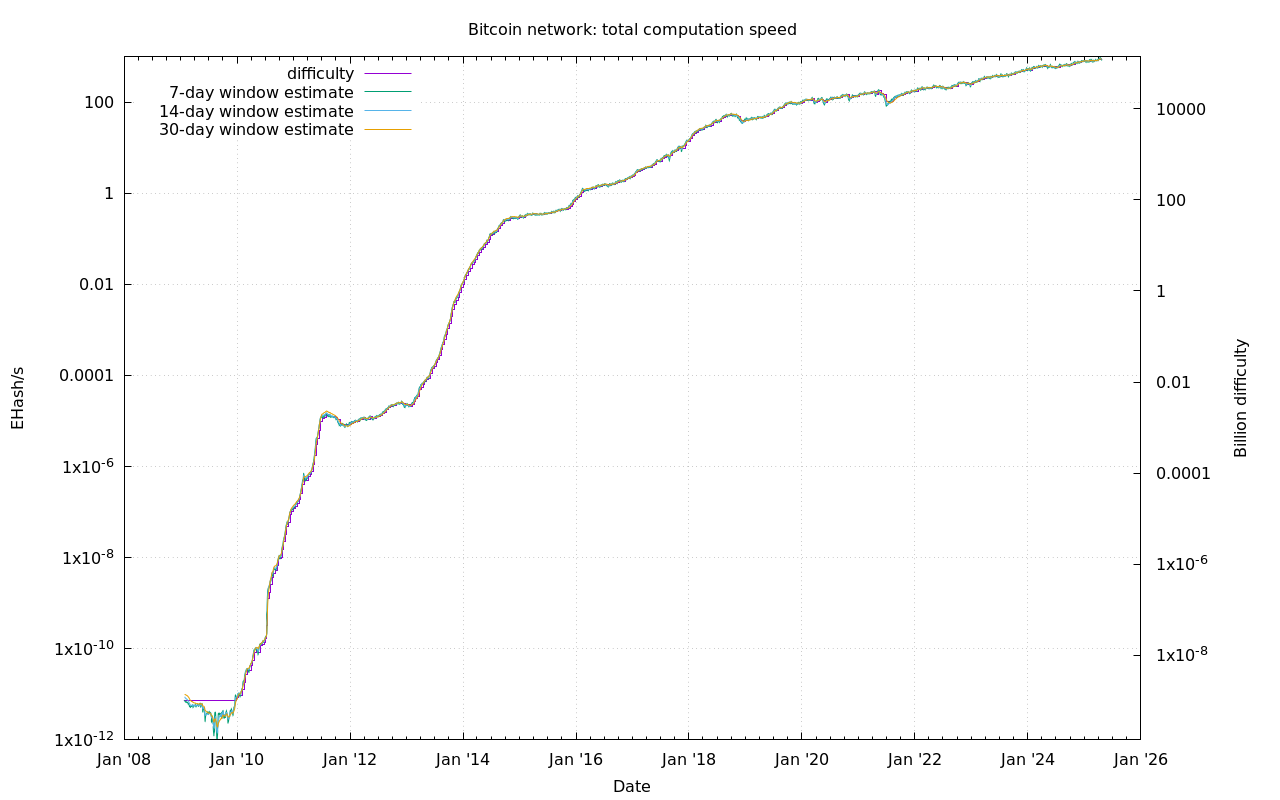

The first event represents the first time mining using a more specialized graphical processing unit (GPU) rather than a more general central processing unit (CPU) was made publicly possible. Since many miners had compatible graphics cards already, we see a tenfold jump in power almost instantly.
The second event represents the first time mining using a single-purpose processor, called an ASIC* was introduced to the market. This time, another rapid increase in processing power is sparked, but without the initial leap.
An ASIC is orders of magnitude faster at the simple, repetitive task of mining bitcoins than a GPU is, and a GPU mines orders of magnitude faster than a comparably priced CPU. In both cases, the new hardware quickly rendered any previous mining methods obsolete.
* Application Specific Integrated Circuit.
---------------
When developing new methods to solve computational problems, a software approach usually works best. The results of purely software-based are often portable as packaged programs, and the dissemination of improvements can be as quick and as cheap as a software update. The feedback loop of testing and improvement is very quick, and there are many languages such as the R, SAS, and Julia that can make software-based solutions a routine task.
Making hardware to solve a problem may sound insane by comparison - why would anyone willingly give up all of those advantages? This is where Field Programmable Gate Arrays come in. An FPGA is essentially a circuit board that can be programmed down to the gate level. That is, a user can write a program in terms of the fundamental particles of computation, OR, NOT, XOR, AND, and NAND gates.
The FPGA takes a set of gate instructions and physically wires itself into the programmed configuration. When set, the FPGA is essentially an ASIC, an processor that can only do one task but potentially much faster than a general purpose computer. However, if needed, an FPGA can be re-programmed, so the advantage of a quick trial-and-error turnaround is there. Also, the program can be disseminated like any other software. The most popular FPGAs cost between $200 and $500 USD.
The bitcoin ASIC started off as an FPGA. Once the FPGA program was made, it took about a year for the first ASICs to be sold. This is encouraging for anyone looking towards FPGAs for the next great leap in statistical computing, as it means the endeavor has commercial viability. Just think how much faster some common methods could become even if only large matrix inversion was made faster.
It's time to start thinking with gates.
Sunday, 26 July 2015
Prediction Assisted Streaming
The online game path of exile has a trick for reconciling a game that requires quick reaction times with the limitations of servers: it predicts the actions of the players. It doesn't have to predict far ahead - a couple hundred milliseconds - to keep the action running smoothly most of the time.
Prediction on this time frame isn't hard in principle; play often involves performing the same short
action repeatedly, such as firing an arrow, so the default prediction is just more of that. When the server predicts incorrectly, it usually has enough time to 'rewind' to the present and handle things as they come. The prediction is just an extra buffering layer that's in place when there is a lot of server lag.
Does video or music streaming do this? Could it?
In a song with a repetitive baseline, could the information to the client computer include: "repeat the sound from time x with the following deviations included in the buffer", rather than "play the following sound"? The "sound at time x" in this case is a note from the baseline and the deviations being the result of a human playing an instrument and not hitting the note exactly the same every time. In a case like that, potentially less data would need to be sent to reproduce the song, allowing for longer buffers or higher sound quality.
Likewise for video. Consider a live video feed of a soccer match, in which a player is running across the field. Video prediction may determine there is an object moving at some speed in some direction and predict a few frames ahead where that object will be, and thus what pixels to draw in that spot. Then the streaming service, making the same prediction, could just send the video information that deviates from this prediction.
For repetitive patterns like an animation of a like a spinning wheel or sparkling logo of a sports team. If the wheel spins in a predictable fashion, internet bandwidth could be saved by describing the movement of the wheel as "spinning as expected", where matching prediction software on the server and client sides both recognize that that part of the screen is taken up by an object in 10-frame loop.
This is different from encoding only the pixels that change from frame to frame. This prediction would incorporate likely changes in a picture based on simple movement patterns or on repetitive animations.
Consider a streaming game of hearthstone, like the last time I pretended to know about video encoding. There are certain animations that regularly impact video quality, such as sand sweeping across the entire screen, that involve a many pixels changing for a non-trivial amount of time. The video encoder does fine when the picture is mostly the same from frame to frame, but introduce one of these effects that causes a lot of pixels change at once, and the quality of the live stream.
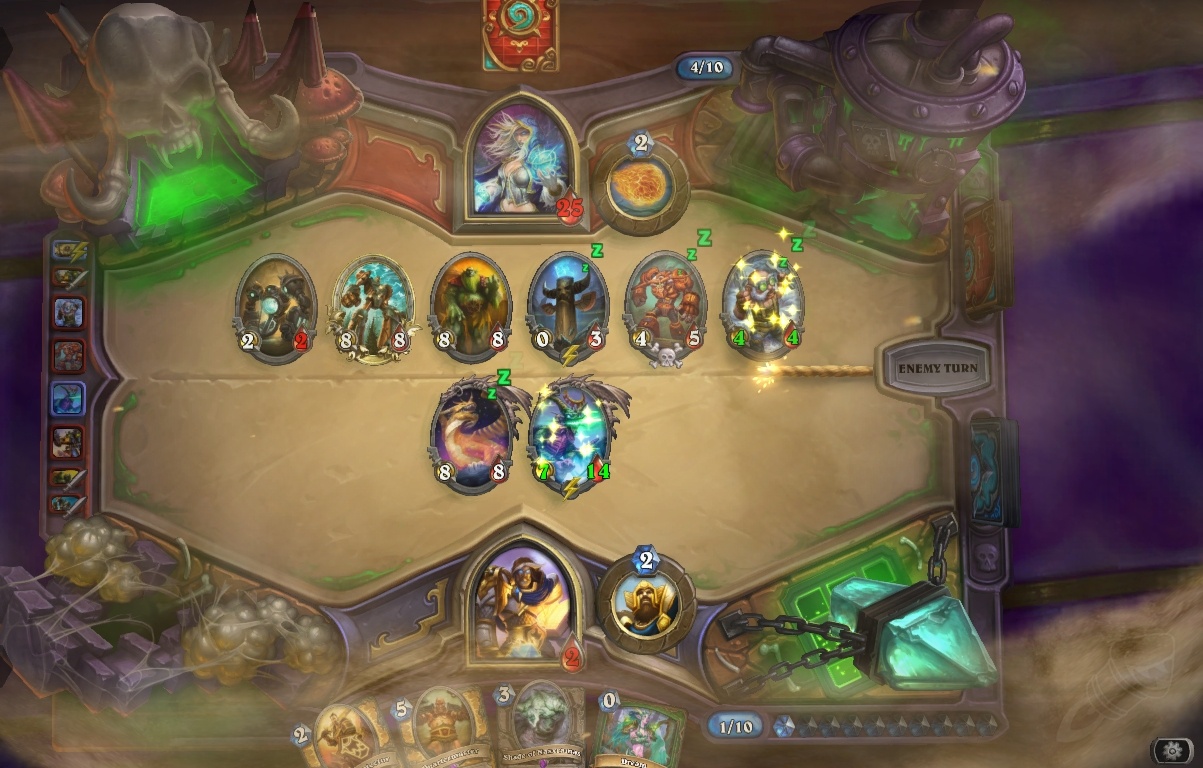
However, the sand effect is one of sand moving slowly across the screen, its movement is predictable in that any one pixel of the effect is likely to follow the same trajectory as it did in the last few frames. Predictive video encoding is more scalable than the application specific encoding I mentioned before, but with time it could achieve the same effect if it was able to recognize frequently used pre-rendered effects such as lightning all over the screen. A predictive video encoder could recognize the first few frames of the 'lightning storm' effect and predict the rest without having to send any information about that part of the screen.

I'm no expert on video encoding, so this may all be jibberish.
Previous post on video encoding in Twitch, the possibility of application specific codecs.
Friday, 8 May 2015
The end of jobs
A friend recently asked me if I foresee any chance of "jobs", or in his words "the economic trade of labour in return for payment" becoming so unsustainable that we as society would abandon it. My response is below.
-----------------
No.
The term "chance" implies that I'm not certain about the unsustainability.
There will NEVER be enough meaningful jobs for everyone. Unemployment is only in a 'healthy' range around 6-7% right now because of a system stretched to its utter limit to create jobs, often at the cost of getting meaningful work done.
First, self employment is counted as jobs in this statistic, as is part time work. So the proportion of people that trade their labour for payment likely a lot smaller than official surface figures.
There are also a large portion of jobs that simply shouldn't be.
- Literally pointless jobs like full-service gas pumps. Really gas stations could be fully automated and could behave like large vending machines.
- Parasitic jobs such as car salespeople, day traders and arbitrageurs. I separate these from pointless jobs because they do perform a service, but only because of legacy systems that mandate that these services are necessary.
- Fields where the output of the field is only loosely related to the number of people working in the field, such as marketing. From the perspective of companies, if half of all ads disappears, the only real effect would be for each remaining ad to be twice as effective. Likewise, the benefit to the consumer, knowledge of a product, would be just as large with perhaps only 10% of ads retained. In that sense, 90% of the work in advertising, from ad creation to posting billboards, is parasitic.
Then there are the jobs that won't be for much longer.
- Physical jobs that are due for automation, such as semi-truck driving.
- Small manufacturing jobs that can be simply replaced by on-demand 3D printing.
- Technical jobs that routinely get automated, like how much search engines have supplanted librarians.
- Many service jobs are a fixed portion of the population, such as teaching, haircutting, and child care. However, the population of countries in the developed world are either flat, declining, or dependant upon immigration to maintain the population increase that modern economics relies upon so dearly.
- Many resource-based jobs are at risk to better energy efficiency, better labour efficiency, and automated landfill harvesting and reclaimation. Even argiculture is being turned upside down by cultured meat. With it, there goes shipping.
Finally, the work that NEEDS to be done such as environmental restoration, medical services, and the development of space technology, simply doesn't work well under an exchange-for-payment system because economically 'rational' people and corporations either won't or can't pay for it.
I would refer you to the 20 minute video "Humans Need Not Apply" for a compelling argument about how this is inevitable. My best resources for universal basic income and on post-scarcity are the novels Accelerando and Red Mars touch on these topics.
-----------------
No.
The term "chance" implies that I'm not certain about the unsustainability.
There will NEVER be enough meaningful jobs for everyone. Unemployment is only in a 'healthy' range around 6-7% right now because of a system stretched to its utter limit to create jobs, often at the cost of getting meaningful work done.
First, self employment is counted as jobs in this statistic, as is part time work. So the proportion of people that trade their labour for payment likely a lot smaller than official surface figures.
There are also a large portion of jobs that simply shouldn't be.
- Literally pointless jobs like full-service gas pumps. Really gas stations could be fully automated and could behave like large vending machines.
- Parasitic jobs such as car salespeople, day traders and arbitrageurs. I separate these from pointless jobs because they do perform a service, but only because of legacy systems that mandate that these services are necessary.
- Fields where the output of the field is only loosely related to the number of people working in the field, such as marketing. From the perspective of companies, if half of all ads disappears, the only real effect would be for each remaining ad to be twice as effective. Likewise, the benefit to the consumer, knowledge of a product, would be just as large with perhaps only 10% of ads retained. In that sense, 90% of the work in advertising, from ad creation to posting billboards, is parasitic.
Then there are the jobs that won't be for much longer.
- Physical jobs that are due for automation, such as semi-truck driving.
- Small manufacturing jobs that can be simply replaced by on-demand 3D printing.
- Technical jobs that routinely get automated, like how much search engines have supplanted librarians.
- Many service jobs are a fixed portion of the population, such as teaching, haircutting, and child care. However, the population of countries in the developed world are either flat, declining, or dependant upon immigration to maintain the population increase that modern economics relies upon so dearly.
- Many resource-based jobs are at risk to better energy efficiency, better labour efficiency, and automated landfill harvesting and reclaimation. Even argiculture is being turned upside down by cultured meat. With it, there goes shipping.
Finally, the work that NEEDS to be done such as environmental restoration, medical services, and the development of space technology, simply doesn't work well under an exchange-for-payment system because economically 'rational' people and corporations either won't or can't pay for it.
I would refer you to the 20 minute video "Humans Need Not Apply" for a compelling argument about how this is inevitable. My best resources for universal basic income and on post-scarcity are the novels Accelerando and Red Mars touch on these topics.
Wednesday, 6 May 2015
Prelude to a FUSS
I apologize in advance if this one is incoherent, as most of it has come in fever dreams over the last couple days.
I want to make a FUSS. That is, a Formula-Unspecified System Solver.
Sunday, 29 March 2015
Laser Tag Rating System
This is a rough outline of an idea that Phil Ophus and I had. We want a rating system for laser tag. We want it to be a cumulative reflection of a player's skill over multiple games. We want a means to compare the laser tag skill of players that have a substantial play record, but not necessarily against each other in the same match. In short, we want an Elo or Trueskill style metric that is a shorthand for "this player is X skilled at laser tag".
However, laser tag has less standardization than the sports and games that these metrics are usually applied to.
As it is now, the single game score cards don't give any context of a skill outside of the single match displayed. Scores in general are higher in matches with many players and longer 'ironman' matches. A score of 50000 can demonstrate just as much achievement as a score of 100000 against equally skilled opponents by these factors alone.
There are strategy factors that affect score that don't fairly reflect skill such as picking mostly weak targets, and aggressive running around play rather than base protection. Besides within-game luck, other random noise is added in from equipment effects; some guns are in better shape than others.
Scores are naturally different between free for all and team games, and some players do better in different formats. However, it's reasonable to assume a strong enough association between the skill levels of a given player across formats that one format can inform the other.
All of this variation, and this is only from a single location: Planet Lazer near Braid Station, New Westminster. At this location, the scoring system rewards hitting much more than it penalizes being hit. Also, every target on a vest is worth the same amount, although this isn't necessarily true at other locations.
We want a ratings method that can be used to compare players in different arenas that may be using different rules. Ideally something anyone could see how well they stack up on a regional up to a worldwide level. However even if we only use places that use comparable equipment, the arenas are substantially different, whereas in many other sports the arena effect is negligible. The rules and scoring systems even differ from place to place.
Our intuition and short train ride's worth of literature searching suggest that no such system exists yet that can handle the non uniform, free for all situations of laser tag. I'm hoping that further developing the cricket similalulator to handle data of cricket players that are compete in multiple formats for multiple teams in a single year.
On the sampling design and logistics side, there are issues with data collection. What if a location's equipment doesn't record a key variable? How long is data retained? Are there enough return players? It seems like the next step is to draw up a research proposal, and bring it to planet Lazer and see if they would let us record their player data like that.
For after the thesis, if at all.
Tuesday, 3 February 2015
Academic Salvage
One of my jobs is to facilitate research grants for educational development through the ISTLD (Institute for the Study of Teaching and Learning in the Disciplines) at Simon Fraser University. The Institute has given more than 130 awards to faculty-lead projects to improve the educational experiences of their classrooms. I've read the grant proposals and final reports of many of these awards and among the patterns that have emerged:
- Almost all the granted projects reach completion close their proposed timeline and submit a final report.
- Many of them mention plans to publish research papers in their proposals.
- Many of them have made measurable beneficial impacts on the experience of students, and these effects are publishable in education journals.
- Many of the final reports mention sharing the findings at on-campus talks and posters.
- Not as many project results actually get submitted to journals, even in response to a follow up a year after the final reports are submitted.
Papers are getting submitted, but not as many as there could be. Sure, there are some There's some barriers at the end of the projects to publishing. Part of the barrier is that the primary goal of the projects is to improve education, not to write about it. Still, it feels like a waste to finish research and write a report and a poster, but never get published credit for it.
I've been told by some colleagues that statistical analysis of the data at the end is often an issue, as well as the paper writing process. It makes me want to find projects that ended in this ABP (all-but-publication) state and offer to write and analyze in exchange for a name on the paper. From my perspective as a statistician and a writer, it seems like one of the most efficient ways to boost my own paper count. From the perspective of a faculty member who has completed such a project, I hope they would consider such an offer as a way to be first author of a real paper rather than sole author of an none.
Is there a name for someone makes these sort of arrangements? If not, I'd like to suggest 'academic salvager'? Specifically, I mean in someone who takes the raw materials from the unpublished research of others and value-adds it up to a paper.
Is there a lot of research in this all-but-publication state in other fields? This is just from one granting program, how much 'academic salvage' is out there waiting to be gathered, refined, and shipped out?
- Many of the final reports mention sharing the findings at on-campus talks and posters.
- Not as many project results actually get submitted to journals, even in response to a follow up a year after the final reports are submitted.
Papers are getting submitted, but not as many as there could be. Sure, there are some There's some barriers at the end of the projects to publishing. Part of the barrier is that the primary goal of the projects is to improve education, not to write about it. Still, it feels like a waste to finish research and write a report and a poster, but never get published credit for it.
I've been told by some colleagues that statistical analysis of the data at the end is often an issue, as well as the paper writing process. It makes me want to find projects that ended in this ABP (all-but-publication) state and offer to write and analyze in exchange for a name on the paper. From my perspective as a statistician and a writer, it seems like one of the most efficient ways to boost my own paper count. From the perspective of a faculty member who has completed such a project, I hope they would consider such an offer as a way to be first author of a real paper rather than sole author of an none.
Is there a name for someone makes these sort of arrangements? If not, I'd like to suggest 'academic salvager'? Specifically, I mean in someone who takes the raw materials from the unpublished research of others and value-adds it up to a paper.
Is there a lot of research in this all-but-publication state in other fields? This is just from one granting program, how much 'academic salvage' is out there waiting to be gathered, refined, and shipped out?
Thursday, 29 January 2015
Abstract Thoughts About Concrete
The production of cement is a major source of anthropogenic (i.e. human-made) carbon dioxide. In fact, its impact is comparable to that of using fossil fuels to transport goods and heat buildings.
It uses limestone, which contains carbon dioxide that has been locked away for a geologic time, and a portion of this is released in the process of cooking it into a material called clinker. Eventually, the cement will re-absorb some, but not all of the CO2 released this way. Cooking the limestone to 1500 C takes a lot of energy too, and in an intensity that makes it difficult to produce cleanly. There's also the costs and impact of the limestone quarrying and transportation to consider.
Another problem is disposal: Construction waste makes up a large part of what goes into landfills, and cement products like concrete and mortar potentially make up a large part of that. This is from buildings being demolished or renovated, from road construction, and from the occasional truckload of concrete that is mixed but can't be poured at the right time.
So I wonder, in my limited understanding, if it's possible to take cement products and reclaim some of the cement. Currently, concrete is recycled to reduce its landfill impact and the need to mine gravel and other fill. However, that seems to be all it's used for - simple rocks rather than the magic gluestone stuff that holds skyscrapers up.
Curing is a one-way chemical process (I think), and that there's a lot of fill that's added to cement to make concrete, so maybe it's just too hard to be profitable. Fresh cement powder is so fine that it would be a stretch to call it dust, so a tremendous amount of mechanical grinding would be necessary to get concrete down to a point where the fill could be removed from what was cement powder before curing.
Has anyone given serious thought to a chemical or biological means of doing this however? If lichen can break down solid rock, could concrete gravel be broken down or separated into something finer with a plant, enzyme, or type of bacterium? Can the curing process be undone by similar means that leaves behind clinker as a waste product?
Similarly, could wet concrete mix be saved for another time in the cases where it spoils from water contamination or when it can't be poured when intended? Could aging or damaged infrastructure be reinforced or renewed by drilling into it and injecting something to force it to re-cure?
Just some thoughts from someone ignorant on the limitations of infrastructure. Comments, corrections and discussion about this would be very welcome.
Here's a general statement to close -- climate change won't simply be fixed by driving hybrids and using recycle bins. It's a complex problem and solving it will be the great work of this and the next generation.
http://en.wikipedia.org/wiki/Environmental_impact_of_concrete
http://en.wikipedia.org/wiki/Concrete_recycling
It uses limestone, which contains carbon dioxide that has been locked away for a geologic time, and a portion of this is released in the process of cooking it into a material called clinker. Eventually, the cement will re-absorb some, but not all of the CO2 released this way. Cooking the limestone to 1500 C takes a lot of energy too, and in an intensity that makes it difficult to produce cleanly. There's also the costs and impact of the limestone quarrying and transportation to consider.
Another problem is disposal: Construction waste makes up a large part of what goes into landfills, and cement products like concrete and mortar potentially make up a large part of that. This is from buildings being demolished or renovated, from road construction, and from the occasional truckload of concrete that is mixed but can't be poured at the right time.
So I wonder, in my limited understanding, if it's possible to take cement products and reclaim some of the cement. Currently, concrete is recycled to reduce its landfill impact and the need to mine gravel and other fill. However, that seems to be all it's used for - simple rocks rather than the magic gluestone stuff that holds skyscrapers up.
Curing is a one-way chemical process (I think), and that there's a lot of fill that's added to cement to make concrete, so maybe it's just too hard to be profitable. Fresh cement powder is so fine that it would be a stretch to call it dust, so a tremendous amount of mechanical grinding would be necessary to get concrete down to a point where the fill could be removed from what was cement powder before curing.
Has anyone given serious thought to a chemical or biological means of doing this however? If lichen can break down solid rock, could concrete gravel be broken down or separated into something finer with a plant, enzyme, or type of bacterium? Can the curing process be undone by similar means that leaves behind clinker as a waste product?
Similarly, could wet concrete mix be saved for another time in the cases where it spoils from water contamination or when it can't be poured when intended? Could aging or damaged infrastructure be reinforced or renewed by drilling into it and injecting something to force it to re-cure?
Just some thoughts from someone ignorant on the limitations of infrastructure. Comments, corrections and discussion about this would be very welcome.
Here's a general statement to close -- climate change won't simply be fixed by driving hybrids and using recycle bins. It's a complex problem and solving it will be the great work of this and the next generation.
http://en.wikipedia.org/wiki/Environmental_impact_of_concrete
http://en.wikipedia.org/wiki/Concrete_recycling
Subscribe to:
Posts (Atom)